Understanding Your JPS Bill
The truth is, electricity bills can be complicated. There are parts JPS controls, parts we don't, and one very important part that YOU control. Let's walk through each one so you can understand exactly what you're paying for and why.
Nobody likes paying the light bill. We get it.
You want to know exactly where your money is going. Choose how you want to see it: decode the line items on your receipt, or follow the physical journey to see who actually gets paid.
Interactive Bill Explorer
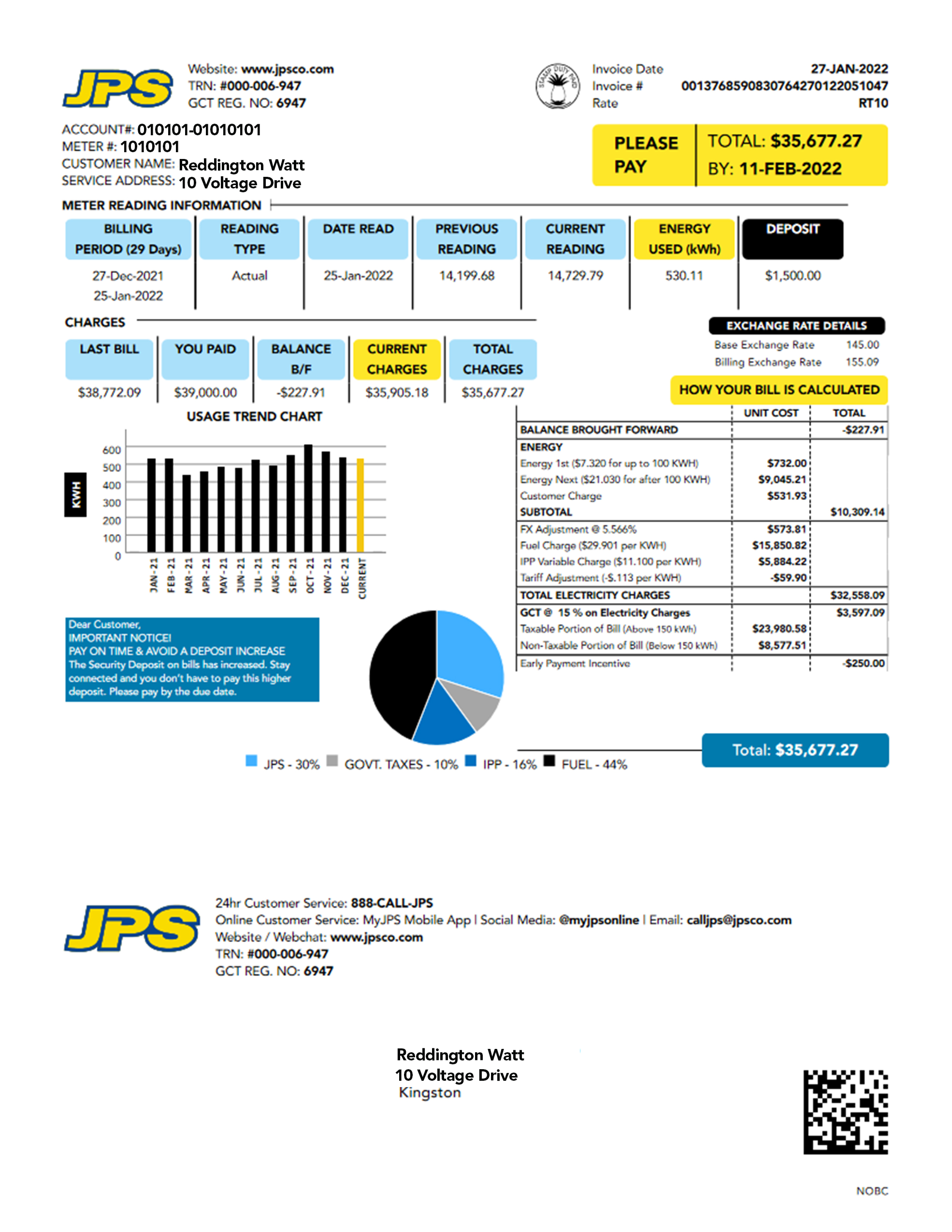
Click any yellow dot on the sample bill below to see exactly what that charge means, why it fluctuates, and who sets the price.
Lower your usage to lower your bill.
There are many moving parts on your bill that are tied to global markets, but your consumption is 100% in your control. Lowering your kWh directly reduces your Fuel, IPP, and Energy charges.
🔌 Unplug When Idle
Chargers, TVs, and appliances still draw phantom power when plugged in. Unplug them when not in use.
❄️ Smart AC Usage
Don't place lamps or TVs near your AC thermostat. The heat causes the AC to work harder and longer than necessary.
💡 Switch to LEDs
LED bulbs use up to 80% less electricity than traditional incandescent bulbs. Make the swap.
The Physical Journey
Watch the breakdown or follow the money to see the physical process behind the numbers.
Beyond the Grid: Other Bill Items
Once electricity reaches your meter, the physical journey ends. The final pieces of your bill are external economic factors and account history.
Common Questions About Your Bill
Everyday questions we get from customers - click any question to see the answer
1. What's the difference between an "Actual" reading and an "Estimated" reading?
Actual reading: A JPS meter reader (or our remote reading system) checked your meter and recorded the exact number showing on it. This is your real usage.
Estimated reading: We couldn’t access your meter (maybe locked gate, dog, inaccessible location, or system issue), so we estimated your usage based on your past bills.
How estimates work: We look at your last 3 actual readings and calculate an average. If you normally use 300 kWh per month, we’ll estimate around 300 kWh.
Important: When we get your next actual reading, we’ll adjust for any difference. If we underestimated, you’ll see a catch-up charge. If we overestimated, you’ll get a credit. You only pay for electricity you actually use.
To avoid estimates: Make sure your meter is accessible – clear any bushes, unlock gates on meter reading day, and ensure dogs are secured.
2. Does JPS Charge more in the summer?
No we don’t. However with Jamaica’s hot summer months (June-September) most people run AC way more than in cooler months. When it’s 32°C outside, that AC is working overtime to keep your house at 22°C.
Real example: A family that uses 400 kWh in January (minimal AC) might use 800 kWh in July (AC running daily). That’s double the usage and it may mean a higher bill.
💡 Summer savings tips:
- Set AC to 25-26°C, not 20-22°C (still comfortable but uses way less power)
- Use fans to circulate cool air instead of running multiple ACs
- Close windows and curtains during the hot day to keep heat out
- Only cool the rooms you’re actually using
- Clean AC filters monthly – dirty filters make AC work harder
3. What is kWh?
kWh = Kilowatt-hour. It’s how we measure electricity, like liters for gas or pounds for rice.
Simple way to think about it: 1 kWh is the amount of electricity it takes to run:
- A typical room AC for 1 hour
- Your fridge for about 24 hours
- Ten 10-watt LED bulbs for 10 hours
- A TV for 10-15 hours
How to track your usage:
- Read your meter: Write down the number today, then check again tomorrow at the same time. The difference is how many kWh you used in 24 hours.
- Use the MyJPS app: It shows your daily usage automatically – way easier!
4. I Think My Bill is wrong, What should I do?
Don’t panic – let’s figure it out step by step:
Step 1: Check if it’s an actual or estimated reading
Look at your bill – it will say “Actual” or “Estimated.” If it’s estimated and seems way off, your next actual reading will correct it.
Step 2: Compare your usage to previous months
Look at the kWh (kilowatt-hours) you used this month vs. last month. Did you actually use more electricity? Maybe you:
- Ran AC more (hot weather?)
- Had guests staying over
- Left something running (water pump, water heater)
- Got a new appliance
Step 3: Check if fuel prices went up
Even with the same usage, your bill can be higher if fuel costs increased that month. Look at the “Fuel Charge” line on your bill.
Step 4: Still think something’s wrong?
- Take photos of your meter reading
- Open the MyJPS app and submit a bill dispute, or
- Call 888-CALL-JPS (225-5577) and ask them to walk you through your bill
- You can also visit any JPS commercial office
5. Can I switch to prepaid electricity? How does it work?
Yes! JPS offers prepaid electricity service.
How prepaid works:
- You buy electricity credit BEFORE you use it (like buying phone credit)
- You top up through the MyJPS app, at authorized vendors, or online
- Your meter shows how much credit you have left
- When credit runs low, you get alerts to top up
- No monthly bills, no surprises – you control your spending
Benefits:
- No security deposit required
- No monthly bills or due dates
- You see exactly how much electricity costs as you use it
- Better budget control – buy what you can afford
- No disconnection notices or late fees
Things to know:
- You need to have a prepaid meter installed (there’s an installation process)
- You still pay all the same charges (energy, fuel, taxes, etc.)
- Your power will go off if you run out of credit, so keep track!
How to switch: Use the MyJPS app to request prepaid service, or call 888-CALL-JPS. We’ll explain the process and costs involved.
6. Why do I have to pay a Customer Charge even when I barely use any electricity?
Think of the Customer Charge like a Netflix subscription or internet service fee.
Even if you don’t watch Netflix all month, you still pay the subscription because the service is available to you 24/7 when you need it.
What the Customer Charge covers:
- Maintaining the poles and wires that connect to your house
- Your meter and its maintenance
- Meter reading (whether actual or remote)
- Billing and customer service systems
- Having electricity AVAILABLE 24/7, ready when you need it
Why it exists: These infrastructure costs exist whether you use 10 kWh or 1000 kWh. The poles still need maintenance, your meter still needs reading, the wires still need to be kept in good condition.
Important: The Customer Charge is set by the Office of Utilities Regulation (OUR), not JPS. It’s the same for all residential customers and covers the fixed costs of providing electricity service
7. What uses the most electricity in my home?
It depends on how you use your appliances and wether they are in good condition or not. But the Big 3 electricity eaters in most Jamaican homes:
- Air Conditioning – By far the biggest. Running AC all day can use 50-60% of your monthly electricity. A single AC unit running 8 hours a day can cost $6,000-$10,000 per month.
- Water Heater – Uses a lot of power to heat water. An electric shower or tank heater running daily can add $3,000-$5,000 to your monthly bill.
- Refrigerator/Freezer – Runs 24/7. An old inefficient fridge can cost $2,000-$3,000 per month. Newer energy-efficient ones cost much less.
Also watch out for: Electric stoves/ovens, clothes dryers, irons, and water pumps.
💡 Biggest impact: Set AC to 25°C instead of 20°C, use it only when you’re in the room, and turn off the water heater when not in use. These three changes alone can cut your bill by 30-40%.