Understanding Your JPS Bill
The truth is, electricity bills can be complicated. There are parts JPS controls, parts we don't, and one very important part that YOU control. Let's walk through each one so you can understand exactly what you're paying for and why.
Understanding The Journey Of Electricity
Your bill isn't just a random number. It reflects the physical cycle of energy—from the power plant, through the grid, to your meter. Here is the breakdown of that cycle.
Phase 1: Generation
Creating the Power.
Before electricity reaches you, it must be generated. This requires fuel (oil & gas). We buy this fuel from global suppliers like Petrojam.
Key Bill Items:
• Fuel Charge: Cost of oil/gas (Pass-through).
• IPP Charge: Power bought from other producers.
Why it fluctuates: Just like gas prices at the pump, fuel costs change monthly based on the global market.
Phase 2: Generation
These rates are set by the OUR, not JPS.
The Infrastructure.
Once generated, power travels through our grid of poles, wires, and transformers to reach your home safely. Maintaining this complex network costs money 24/7.
Key Bill Items:
• Customer Charge: Fixed monthly ``subscription`` fee.
• Energy Charge: Operational costs (Regulated).
Phase 3: Consumption
Your Daily Usage.
This is the active phase. Your home draws energy to power your daily life—from cooling to entertainment. The total electricity (kWh) used by your appliances sets the baseline for your bill, meaning your efficiency choices have the biggest influence on the final amount.
Did you know?
The Big 3 Energy Users:
AC (Can be 50% of bill!)
Water Heater
Inefficient Fridge
Phase 4: Valuation
FX Adjustment
When the Jamaican dollar fluctuates against the US dollar, the ``Billing Exchange Rate`` on your invoice changes to match the real cost of purchasing fuel.
The Exchange Rate.
Because the fuel used to generate power is purchased in US Dollars, the value of the Jamaican Dollar impacts the final calculation of your bill.
Phase 5: Taxation
Government Taxes.
Finally, the Government applies taxes to electricity services. We collect this on behalf of the government and pass it directly to the Tax Administration.
GCT Update
Effective May 2025, the General Consumption Tax (GCT) for residential customers has been reduced from 15% to 7%.
Now that we understand the journey
Let's go into more details
SHOWCASING CLARITY & TRANSPARENCY WHEN YOUR BILL COMES TO YOU!
Understanding Your Bill
Billing Period
The billing period is the exact period of electricity usage on which this each is based. It tells you the start and end dates during which your meter recorded the energy you are now being charged for.
The billing period can be found at the top left below Meter Reading Information.
The bill pictured is based on usage for the billing period 27-Dec-2021 to 25-Jan-2022 (29 days).
Your Bill Format
If you want to know what your bill is based on, this is where you look. Your bill may be based on an actual meter reading or an estimated reading calculated using an average of three; 3 recent actual meter readings.
The amount of energy you used
This is the only part of your bill you have direct control over. The more electricity you use, the more you pay. The less you use, the less you pay. Small changes in your habits like using enegry efficient devices can lower your total bill.
Learn How To Manage Your EnergyCost & Fees
What it is: A fixed monthly fee - like a subscription fee. It stays the same whether you use 50 kWh or 500 kWh.
What it covers: Maintaining the poles, wires, transformers, meters, and systems that bring electricity to your home. Think of it like paying for the road even when you're not driving on it - the infrastructure needs to be there and working.
Non- Fuel Charges
This covers the actual cost of producing and delivering electricity to your home.
How it works:
The Energy Charge depends on how many kilowatt-hours (kWh) you use each month. More usage = higher energy charge. This is why monitoring your consumption is so important.
Calculating Fuel Charges
What it is: The cost of the natural gas and oil needed to run the power plants that generate your electricity. This is usually the BIGGEST chunk of your bill - often over 50%.
Why it changes:
JPS and the Independent Power Producers (IPPs) buy fuel from suppliers like Petrojam and Excelerate Energy. When prices go up on the world market, that cost gets passed through. JPS doesn't profit from the fuel charge - it's a pass-through cost based on actual fuel used.
Learn More About Fuel RateIPP Charges
What it is: Sometimes JPS doesn't generate all the electricity Jamaica needs, especially during peak times. So we buy extra electricity from Independent Power Producers (IPPs) - other companies that have power plants.
Why this exists: To make sure you always have electricity when you need it, even when demand is really high (like when everyone turns on AC at 6pm).
Maximum Peak Requirements Cost
The Demand Charge is designed to cover costs related to the generating capacity that JPS has to put in place and maintain in order to serve the maximum (peak) requirements of each customer. It is listed as a separate item for Rates 40 and 50 customers only, but it is included in the Energy Charge for other rate classes.
Basis To Calculate Foreign Exchange Rate
This refers to the foreign exchange rate that was used by the OUR to develop the rates published in the Rate Schedule. It is used as the basis for calculating the foreign exchange adjustment on your bill.
Average Foreign Exchange Rate During Billed Period
This is the average foreign exchange rate that exists during the period for which you are being billed. It is used along with The Base Exchange Rate to calculate the foreign exchange adjustment factor on your bill.
Foreign Exchange Costs & Fees
The foreign exchange rate changes regularly, and a significant portion of the costs of producing and delivering electricity is based on US dollars. As a result, each month the exchange rate applied to your bill has to be calculated to show [movement in the US Dollar viz-a-viz the JA Dollar]
Taxes (GCT)
What it is: General Consumption Tax - just like the tax you pay when you buy food or clothes. This goes to the Government of Jamaica, not to JPS.
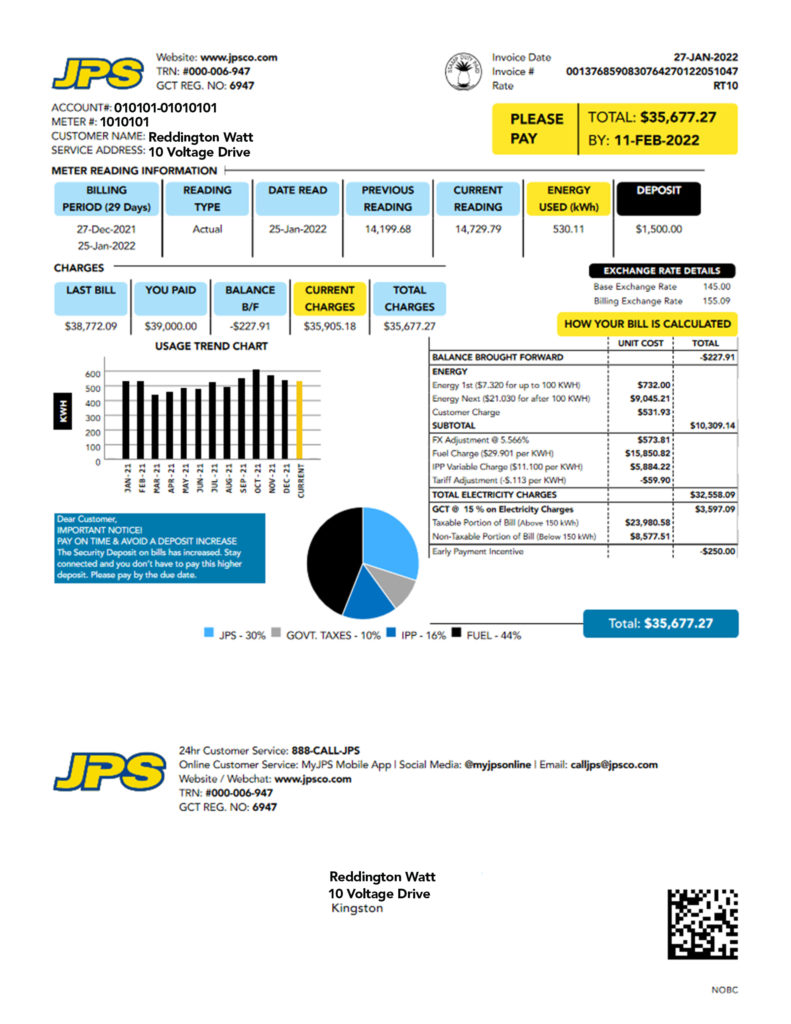
Reading Type
If you want to know what your bill is based on, this is where you look.
Customer Charge
This is a fixed monthly charge to cover the cost of meters, meter maintenance, bill delivery, etc
Fuel Charge
This charge is based on the cost of the oil and gas used to generate electricity.
IPP Charge
This charge is for electricity we buy to sell to you, our customers.
Base Exchange Rate
This refers to the foreign exchange rate that was used by the OUR to develop the rates published in the Rate Schedule.
Billing Exchange Rate
This is the average foreign exchange rate that exists during the period for which you are being billed.
IMPACT OF HURRICANE MELISSA ON BILLS
With the recent passage of the Category 5 Hurricane Melissa, there was significant disruption in our operations, including the billing process. In addition, many persons lost supply for varying periods as a result of extensive damage to the electricity infrastructure. In light of this, we are providing answers to questions you may have about the impact of the hurricane on your bills.
Q1: Will I be billed for actual usage or will they get estimated bills?
Most bills will be based on actual meter readings. Where we are able to get an actual meter reading, your bill will reflect the electricity you used, whether you had service for a few days or for the full billing period.
A small number of customers may receive estimated bills because damage to communication systems prevented us from getting readings from some smart meters after the hurricane. We recognise that some persons had electricity only for a part of the billing period, while others had service for the full period. Your estimated bill will, for the most part, reflect only the days for which our records show that you had service.
Q2: Will I still be billed even though I have not had electricity since the hurricane?
We recognise that although the majority of our customers now have electricity, unfortunately some persons are still without service because of the extensive damage to the network. Where your community is still without supply and there was no electricity usage on your premises for the entire billing period, your bill will show zero consumption.
-
- JPS will waive the Customer Charge
- No other charge will be applied to this bill
- Any previously unpaid amount will appear as Balance Brought Forward.
Q3: Has the hurricane impacted the cost of electricity?
The events surrounding Hurricane Melissa affected how Jamaica was able to produce and receive electricity during the period.
-
- Fuel Supply: Our regular natural gas (LNG) supply was temporarily unavailable because the supplier had to secure its infrastructure at sea before the storm. This required JPS and IPPs to rely on more expensive fuels such as on Heavy Fuel Oil (HFO) and Automotive Diesel Oil (ADO), coupled with the use of less efficient generation for reliability reasons.
-
- Renewable Energy: Jamaica’s renewable generation—such as wind and solar—was significantly reduced due to weather conditions and damage to equipment during and after the storm.
-
- Reduction in energy sales: The passage of Hurricane Melissa also resulted in a reduction of approximately 30% in sales. The fixed costs associated with Fuel and the electricity from Independent Power Producers had to be spread over fewer kilowatt-hours.
These factors influenced the overall cost of generating electricity during the billing cycle.
Q4: Will there be higher charges on my bill because of the hurricane?
Yes, the Fuel Charge on December bills is higher than the charge on November bills, moving from $27.65 per kilowatt-hour to $29.84 per kilowatt-hour. In addition, the lower sales after the hurricane has resulted in a higher IPP Variable Charge. The new IPP Variable Charge $11.19 per kWh, up from last month’s $9.28 per kWh.
Q5. What is the overall increase on customers’ bills this month?
For an average customer whose energy usage remains consistent, there will be an increase of about 7% on December bills, compared to November bills. This means that:
-
- An average residential customer using 165 kWh of electricity will see an increase of about $652 on his or her bill.
- A customer using 250 kWh will see an increase of about $1000.
- A customer who uses 350 kWh will see an increase of approximately $1525, compared to the previous bill.
The average increases for different usage levels are as follows:

Q6: Couldn’t JPS have absorbed this increase, in light of the challenges customers are facing recovering after the impact of hurricane?
The Fuel and IPP Charges are costs that are passed through to customers each month, to pay for the fuel and the extra electricity needed to serve customers. These are bills that JPS has to pay each month to the suppliers. These costs change from one month to the next, sometimes resulting in increases and at other times in decreases in customers’ bills.
The additional cost incurred because of Hurricane Melissa is not being fully passed on to customers at this time. That’s because JPS worked with the gas supplier, Excelerate Energy to partially offset millions of dollars, thereby reducing the actual cost passed on to customers.
In order to prevent bill shock for customers, JPS proactively proposed to the Office of Utilities Regulation (OUR) a mechanism to defer the fuel bill over several months, which the regulator approved.
In the absence of these mitigation measures, the bill impact would have been much higher.
Q7: Why didn’t JPS use more renewables after the hurricane, instead of the expensive fuel?
Renewables could not have been used immediately after the hurricane because:
-
- The Transmission Lines that takes the power from key renewable plants in St Elizabeth and Manchester were severely damaged by the hurricane.
-
- Energy from Wind and Solar is variable in nature, and cannot maintain grid stability. Introducing them too early in the restoration process would have increased the risks of operating the grid, leading to instability and load shedding.
-
- The 37MW solar plant in Westmoreland was completely destroyed by the hurricane and remains unavailable to supply the grid.
Q8: Hurricane Melissa disrupted my life and I just cannot pay this bill, what am I to do?
You can request a payment extension or set up a payment plan using the MyJPS Mobile App or by contacting our Customer Care Centre at 888-CALL-JPS (225-5577) or 888-935-5577.
Q9. Why am I getting a bill when I was without electricity for weeks after Hurricane Melissa?
While some customers were without electricity for the entire billing period, others did not lose electricity at all, and many got back power at varying points during the billing period. The majority of the customers with electricity will get bills based on actual meter readings. If you are one of these customers, your bill will reflect your actual usage, so you are only being billed for the electricity you used during the billing period.
A small percentage of customers will get bills based on estimates because interruptions in the communication services prevented us from getting readings from your smart meters as scheduled. These estimates are calculated using the last three actual readings obtained from your meter.
[Please pay close attention to your bill, because if there was an outstanding unpaid balance, this will also be reflected on the bill you are getting in December.]
Q10. Why is my bill being estimated when I have a smart meter?
Hurricane Melissa caused significant damage to infrastructure, resulting in interruptions in communication services. This prevented JPS from getting remote readings from the smart meters as scheduled. The estimated bills are calculated using the average of the last three actual readings.
Common Questions About Your Bill
Everyday questions we get from customers - click any question to see the answer
1. What's the difference between an "Actual" reading and an "Estimated" reading?
Actual reading: A JPS meter reader (or our remote reading system) checked your meter and recorded the exact number showing on it. This is your real usage.
Estimated reading: We couldn’t access your meter (maybe locked gate, dog, inaccessible location, or system issue), so we estimated your usage based on your past bills.
How estimates work: We look at your last 3 actual readings and calculate an average. If you normally use 300 kWh per month, we’ll estimate around 300 kWh.
Important: When we get your next actual reading, we’ll adjust for any difference. If we underestimated, you’ll see a catch-up charge. If we overestimated, you’ll get a credit. You only pay for electricity you actually use.
To avoid estimates: Make sure your meter is accessible – clear any bushes, unlock gates on meter reading day, and ensure dogs are secured.
2. Does JPS Charge more in the summer?
No we don’t. However with Jamaica’s hot summer months (June-September) most people run AC way more than in cooler months. When it’s 32°C outside, that AC is working overtime to keep your house at 22°C.
Real example: A family that uses 400 kWh in January (minimal AC) might use 800 kWh in July (AC running daily). That’s double the usage and it may mean a higher bill.
💡 Summer savings tips:
- Set AC to 25-26°C, not 20-22°C (still comfortable but uses way less power)
- Use fans to circulate cool air instead of running multiple ACs
- Close windows and curtains during the hot day to keep heat out
- Only cool the rooms you’re actually using
- Clean AC filters monthly – dirty filters make AC work harder
3. What is kWh?
kWh = Kilowatt-hour. It’s how we measure electricity, like liters for gas or pounds for rice.
Simple way to think about it: 1 kWh is the amount of electricity it takes to run:
- A typical room AC for 1 hour
- Your fridge for about 24 hours
- Ten 10-watt LED bulbs for 10 hours
- A TV for 10-15 hours
How to track your usage:
- Read your meter: Write down the number today, then check again tomorrow at the same time. The difference is how many kWh you used in 24 hours.
- Use the MyJPS app: It shows your daily usage automatically – way easier!
4. I Think My Bill is wrong, What should I do?
Don’t panic – let’s figure it out step by step:
Step 1: Check if it’s an actual or estimated reading
Look at your bill – it will say “Actual” or “Estimated.” If it’s estimated and seems way off, your next actual reading will correct it.
Step 2: Compare your usage to previous months
Look at the kWh (kilowatt-hours) you used this month vs. last month. Did you actually use more electricity? Maybe you:
- Ran AC more (hot weather?)
- Had guests staying over
- Left something running (water pump, water heater)
- Got a new appliance
Step 3: Check if fuel prices went up
Even with the same usage, your bill can be higher if fuel costs increased that month. Look at the “Fuel Charge” line on your bill.
Step 4: Still think something’s wrong?
- Take photos of your meter reading
- Open the MyJPS app and submit a bill dispute, or
- Call 888-CALL-JPS (225-5577) and ask them to walk you through your bill
- You can also visit any JPS commercial office
5. Can I switch to prepaid electricity? How does it work?
Yes! JPS offers prepaid electricity service.
How prepaid works:
- You buy electricity credit BEFORE you use it (like buying phone credit)
- You top up through the MyJPS app, at authorized vendors, or online
- Your meter shows how much credit you have left
- When credit runs low, you get alerts to top up
- No monthly bills, no surprises – you control your spending
Benefits:
- No security deposit required
- No monthly bills or due dates
- You see exactly how much electricity costs as you use it
- Better budget control – buy what you can afford
- No disconnection notices or late fees
Things to know:
- You need to have a prepaid meter installed (there’s an installation process)
- You still pay all the same charges (energy, fuel, taxes, etc.)
- Your power will go off if you run out of credit, so keep track!
How to switch: Use the MyJPS app to request prepaid service, or call 888-CALL-JPS. We’ll explain the process and costs involved.
6. Why do I have to pay a Customer Charge even when I barely use any electricity?
Think of the Customer Charge like a Netflix subscription or internet service fee.
Even if you don’t watch Netflix all month, you still pay the subscription because the service is available to you 24/7 when you need it.
What the Customer Charge covers:
- Maintaining the poles and wires that connect to your house
- Your meter and its maintenance
- Meter reading (whether actual or remote)
- Billing and customer service systems
- Having electricity AVAILABLE 24/7, ready when you need it
Why it exists: These infrastructure costs exist whether you use 10 kWh or 1000 kWh. The poles still need maintenance, your meter still needs reading, the wires still need to be kept in good condition.
Important: The Customer Charge is set by the Office of Utilities Regulation (OUR), not JPS. It’s the same for all residential customers and covers the fixed costs of providing electricity service
7. What uses the most electricity in my home?
It depends on how you use your appliances and wether they are in good condition or not. But the Big 3 electricity eaters in most Jamaican homes:
- Air Conditioning – By far the biggest. Running AC all day can use 50-60% of your monthly electricity. A single AC unit running 8 hours a day can cost $6,000-$10,000 per month.
- Water Heater – Uses a lot of power to heat water. An electric shower or tank heater running daily can add $3,000-$5,000 to your monthly bill.
- Refrigerator/Freezer – Runs 24/7. An old inefficient fridge can cost $2,000-$3,000 per month. Newer energy-efficient ones cost much less.
Also watch out for: Electric stoves/ovens, clothes dryers, irons, and water pumps.
💡 Biggest impact: Set AC to 25°C instead of 20°C, use it only when you’re in the room, and turn off the water heater when not in use. These three changes alone can cut your bill by 30-40%.